|
|
|

|
- The Art Of Narrative Momentum—A Reach Your Apex original from the archives
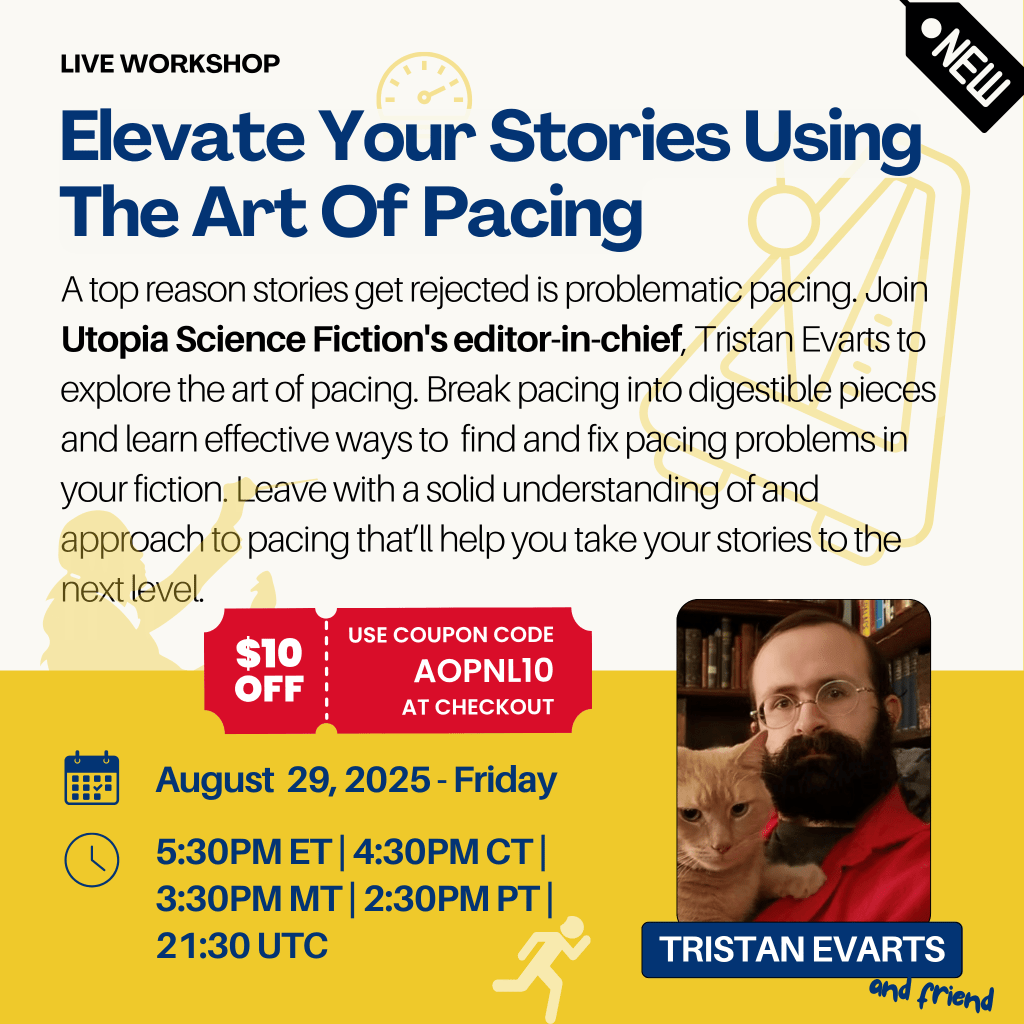
- SOON! AUGUST 29: Elevate Your Stories Using The Art Of Pacing with Editor-In-Chief of Utopia Science Fiction Magazine, Tristan Evarts—newsletter discount
- Markets and contests with submissions open or opening soon
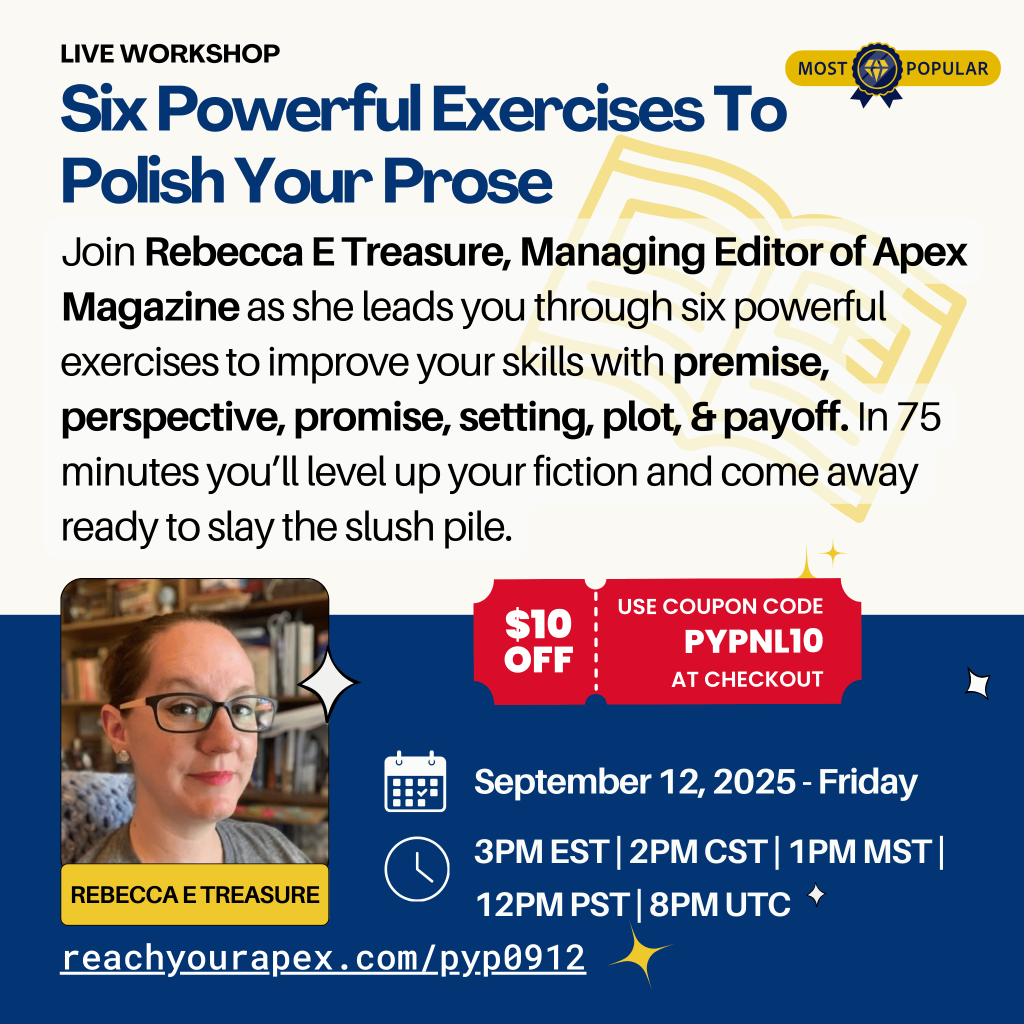
- Coming September 12, 3pm Eastern: Six Powerful Exercises To Polish Your Prose, with Apex Magazine Managing Editor, Rebecca E Treasure—registration open, newsletter discount code
- Save the date: September 27, 1pm Eastern—Good To Extraordinary: The Power of Point Of View with award-winning storyteller, Sage Tyrtle.
|
|
|
|
|
|
|

|
|
They say to be a good writer, you need to be a good reader. Until recently, it never occurred to me that this should include both fiction and nonfiction (excepting for the better books on writing). Many of you are probably saying “Duh”… but writers hear me out, because Moneyball by Michael Lewis provides a great study in something I think of as ‘narrative momentum’, an important facet to writing a compelling story.
|
|

|
Moneyball is a book published in 2003 about Oakland A’s general manager Billy Beane and his use of sabermetrics (a form of statistical analysis defined and popularized by Bill James) to determine a player’s batting effectiveness. At the time, the use of sabermetrics was quite revolutionary. If there is any institution stuck in its traditions and the thought structure of “well, it’s how we’ve always done it” mentality, it’s the game of baseball. The baseball purist will generally be proud of this blinders-to-the-real world thinking… or used to be. Billy Beane and his assistant Paul DePodesta built a mathematical system to predict how many wins a team would have based on the players on its team versus the team’s opponents. This allowed Beane and DePodesta to select quality players nobody else wanted at bargain prices. Because Oakland maintained the third lowest payroll (something around $45,000,000 a year) in the major leagues, finding quality bargain players was necessary in order to compete for a championship.
|
So Bean and DePodesta built a team their computer estimated would win 95 games. The A’s went on to win 103 games and place first in the toughest division in baseball (though they ended up losing in the first round of the playoffs...more on that later). Along the way, they won an American league record 20 games in a row.
|
This story doesn’t sound terribly exciting for anybody but mathematicians and baseball general managers. Throwing Brad Pitt and Jonah Hill into the mix for a wonderful film adaptation co-written by Aaron Sorkin that ratchets the dramatic stakes incredibly high led me to read the book by Michael Lewis.
|
|
While the book focuses on Beane, his draft day antics, his hysterical tantrums, the dismay and disbelief of his staff and players, he isn’t the driving force behind the book. No, the driving force is the story of a little known player named Scott Hatteberg.
|
|
Michael Lewis builds the heart of his narrative around Hatteberg, a likable and congenial guy, beginning with his waning days as a Boston Red Sox catcher. Hatteberg was injured in a manner that meant he could never play the position of catcher again. He’d always played catcher. Going as far back as his little league team. Lewis gives the reader a bit of background about Hatteberg’s life, playing catcher, the positive role baseball played in his life. The Red Sox let Hatteberg go, even though he was a moderately effective hitter.
|
Billy Beane offered Hatteberg a contract with one caveat–Hatteberg would have to play first base because Oakland needed to use someone else in the DH position. Lewis gives us scenes of the player and his wife and child hitting him ground balls in the rain in their backyard. His coaches tell us cringeworthy stories about Scott and his inability to play first base using game situations as examples.
|
Through all this, Michael Lewis has been generating reader sympathy for Scott Hatteberg. He’s also been pushing the narrative forward smartly interspersing the larger, less emotional story of Billy Beane and the A’s transformation with that of the underdog first baseman.
|
The book reaches its climax when the A’s are playing the hapless Kansas City Royals. The A's have won 19 games straight, tying the record. Lewis slows down time, giving us a near inning by inning breakdown. The A’s jump out to a large lead… 11 to 0, with their ace pitcher on the mound. The record looks in the bag. Then the unthinkable happens. The Royals mount an incredible rally. The A’s go from ecstatic record breakers to the gang of losers the league still believes them to be. The Royals tie the game and send it into extra innings, tied 11 apiece.
|
The manager, disliking Billy Beane’s strategy, had decided to sit Scott Hatteberg in favor of a more preferred player. So Scott had spent most of the game in the players clubhouse drinking coffee rooting for his team. The manager calls on Hatteberg to pinch hit. He has to hurry to prepare, even grabbing the wrong bat (most players in the big leagues sign with Louisville Slugger to use specially designed bats for their exclusive use).
|
Hatteberg, with two strikes, blasts a walkoff pinch hit homerun. The A’s go wild. And good ol’ Hatteberg, the player nobody wanted, the player other made fun of at first base, the player even the manager didn’t want, saves the day and gives the A’s the record.
|
Win one for the little guys, right?
|
In the book’s denouement, we’re told Hatteberg went on to become well-regarded for his fielding skills at first base, that the A’s won 103 games, and before long just about every team hired a sabermetrics expert.
|
As an editor, I recommend that a great way to engage the reader is to keep your story surging forward, usually on the back of a sympathetic character. Being nonfiction, Michael Lewis had a real-life one tailor made in Scott Hatteberg. Naturally, writing and being successful in creating narrative momentum is easier said than done. Sometimes you need to read a good book to get a handle on certain arts of the craft of writing. And sometimes, you’re given examples of craft in the most unexpected of stories.
|
|
|
|
|
|
|
A top reason stories get rejected is problematic pacing. Join Utopia Science Fiction's editor-in-chief, Tristan Evarts to master the art of pacing. Tristan breaks pacing into digestible pieces and shares effective ways to find and fix pacing problems in your fiction. Leave with a solid understanding of and approach to pacing that’ll help you take your stories to the next level.
|
|
|
|
In this class, we’ll delve into the essential elements of pacing that you can use to take your story from good to great and make it stand out in the slush pile. You’ll learn:
|
- what your story must have before you can manipulate pacing,
- the technical tools of pacing, and
- the story elements essential to well-paced story.
|
Through the expert guidance of a seasoned editor with over seven years experience, you’ll discover how to balance action with world-building and character-building to create stories that drive the reader from sentence to sentence, paragraph to paragraph, opening to finale.
|
|
You’ll leave this workshop with a solid understanding of and approach to pacing that will empower you to take your stories to the next level. Get $10 off using coupon code AOPNL10.
|
|
|
|
|
|
|
|
Markets and Contests
|
|
Many thanks to Scribophile for sponsoring this week's open submissions. Scribophile is a free welcoming community of writers where you're guaranteed to get solid critiques on your work. You can also get 20% off your first purchase using coupon code APEX20.
|
|
- 🧌 The Fairy Tale Magazine is open to submissions of short fiction and poetry on the theme of “Trolls”! Send them stories between 900 and 2,000 words, or poems of up to 500 words, before August 21st. No submissions fee! 💰Paying market!💰
- 🗝️ Search For the Any Key is a forthcoming anthology featuring treasure hunts and quests. Send them stories between 1,000 and 7,000 words before August 29th. No submissions fee! 💰Paying market!💰
- 📝 Dimly Writ is open to submissions of short fiction of up to 2,500 words or poetry of up to 50 lines. Send them up to three stories or up to five poems. No submissions fee!
- 📰 trampset is looking for submissions of short fiction and creative nonfiction of up to 3,000 words, or up to three poems. They offer fee-free submissions for “broke writers”. No submissions fee! 💰Paying market!💰
- 🌱 Cornice is open to submissions of short fiction and poetry, particularly that which relates to the natural world. Send them between 500 and 3,500 words of either genre. No submissions fee! 💰Paying market!💰
- 🏡 The Signal House Edition is open to submissions of short stories, personal essays, and poems. Submit up to 2,000 words of fiction, 1,000 words of creative nonfiction, or 60 lines of poetry. No submissions fee!
- 🏝️ The Shore is open to submissions of up to five poems in any style. Their current window goes until September 1st. No submissions fee!
- 🖋️ The Pomegranate London is open to submissions of short fiction, creative nonfiction, and poetry. Send them up to 4,000 words of prose writing or up to four poems. No submissions fee!
- 🏚️ Tears in the Fence is open to submissions of poetry, short fiction, and creative nonfiction. Send them up to six poems, or up to 3,500 words of prose writing. No submissions fee!
- ⛪️ Pithead Chapel is looking for submissions of literary fiction, creative nonfiction, and prose poetry up to 4,000 words. No submissions fee!
- ✒️ Penstricken is open to submissions of short stories and poems on the theme of “Machinery”. Send them stories of up to 5,000 words or up to four poems before August 31st. No submissions fee!
- 📖 Prole, Poetry, and Prose is open to submissions of poetry, short stories, and narrative nonfiction. Send them up to 7,500 words of prose writing or up to five poems in any style. No submissions fee!
- ☠️ Bare Bones Publishing is looking for speculative short stories for a forthcoming anthology. Send them work between 800 and 3,000 words before August 25th. No submissions fee!
- 📕 Watertower Hill Publishing is open to submissions of full-length novels and short story collections for adult, YA, and MG readers. Send them a query letter, synopsis, and the first three chapters or stories. No submissions fee! 💰Paying market!💰
- 📙 Sunbury Press is open to direct submissions of full-length books in a large range of imprints including ones for history, cookbooks, crafts, paranormal, spirituality, literary fiction, horror fiction, YA, and more. Send them a detailed summary and proposal. No submissions fee! 💰Paying market!💰
|
|
|
|
|
Registration Open
|
|
|
|
|
|
|
|
|
|
September 27 at 1pm Eastern, world-renowned award-winning storyteller Sage Tyrtle is back with a workshop you won't want to miss, Good To Extraordinary: The Power of Point Of View.
|
Dive into first, second, and third person perspectives, learning how each shapes reader connection and emotional impact. We'll use these tools to heighten tension, control reveals, and make every narrative choice intentional. Through guided exercises, you’ll see how POV works transform good stories into extraordinary ones.
|
|
|
|
|
|
Thank you so much for being a newsletter subscriber. We love our supportive, weird, and wonderful community. Don't hesitate to reply to this email if you have something to tell us. I read every email and will respond.
|
|
|
|
|
|
|
|
|