|
|
|

|
- The managing editor of Apex Magazine shares her checklist for what makes a flash fiction story work
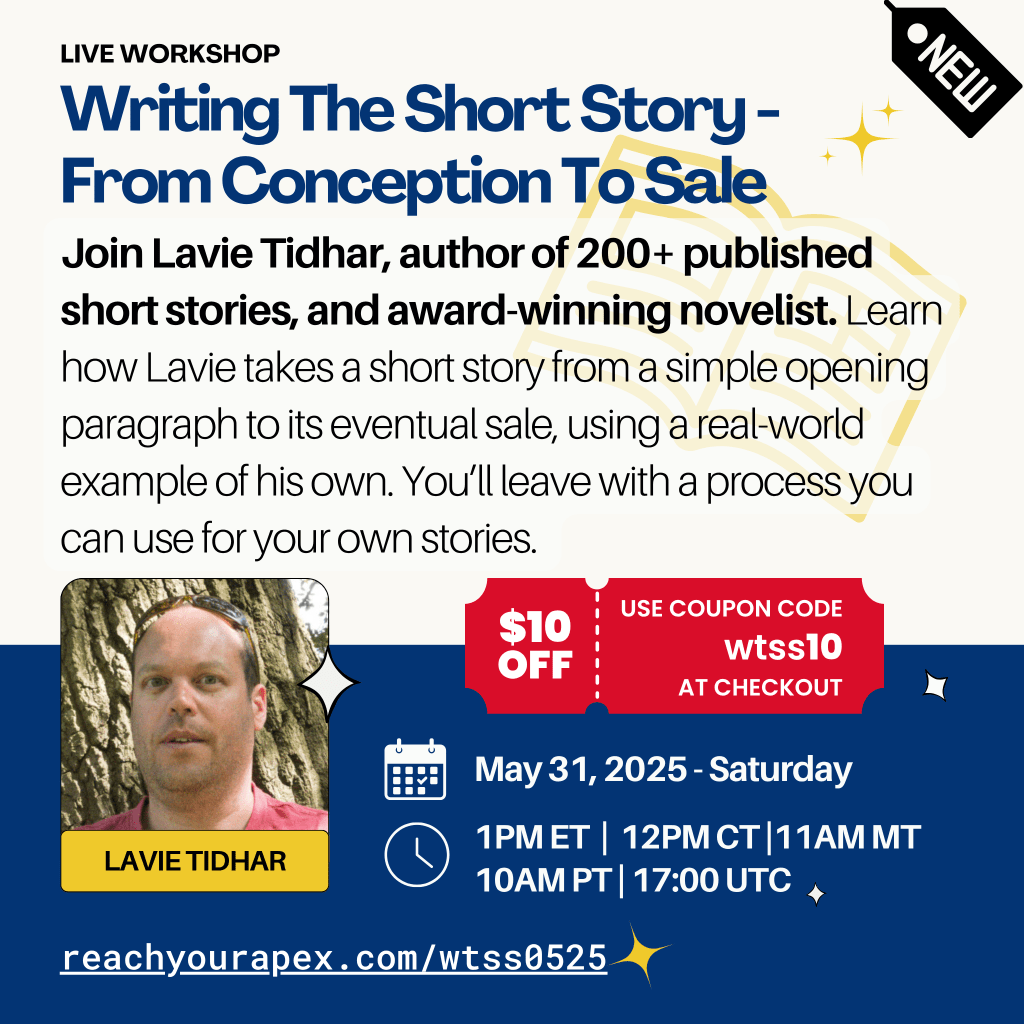
- Discount code for Writing The Short Story - From Conception To Sale live workshop with Lavie Tidhar happening Saturday
- Submissions open
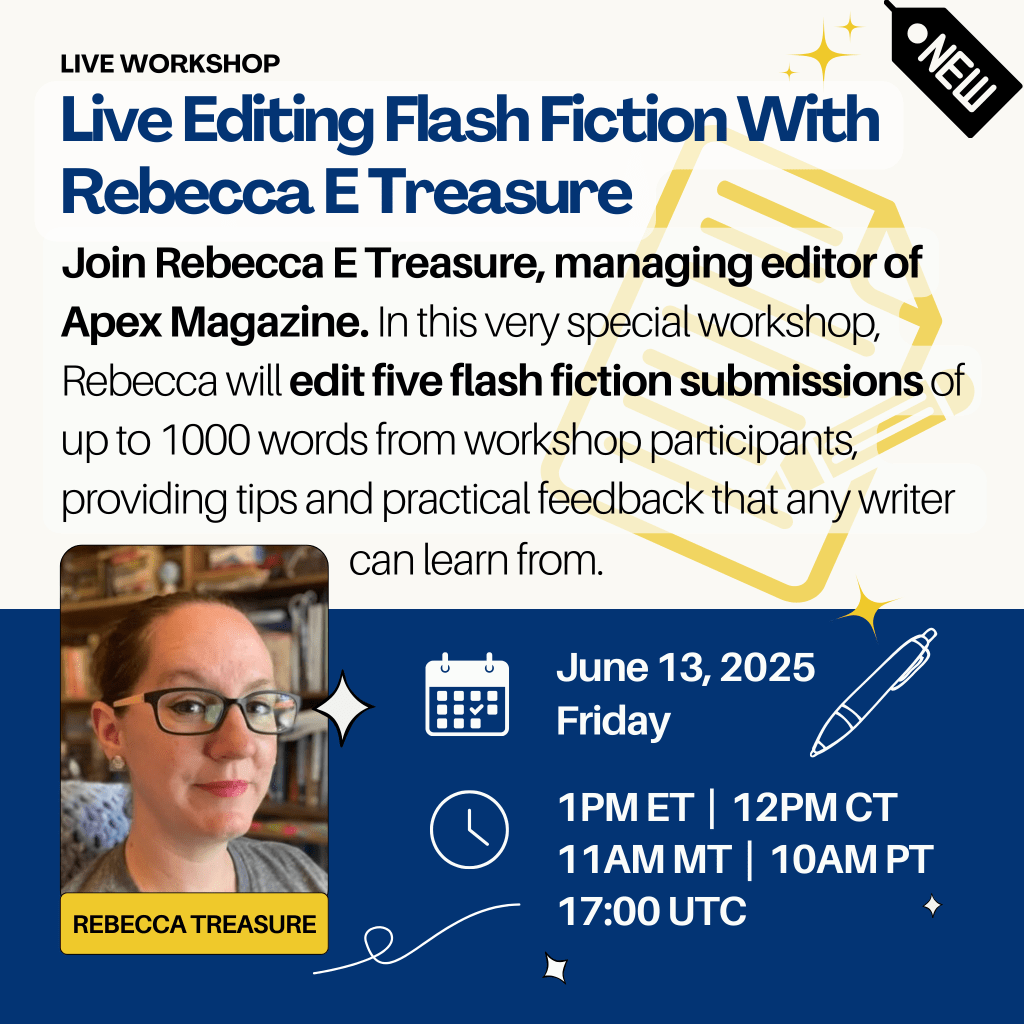
- 1 spot left to get your flash fiction story live-edited by Apex Magazine Managing Editor, Rebecca E Treasure — unlimited audience spots available for just $15
- Read this week's community drabbles—the theme was "scarcity"
- Coming Soon: Writing Within Constraints To Unlock Your Creativity live workshop with Moth GrandSLAM Champion, Sage Tyrtle - get $10 off
|
|
|
|
|
|
|
|
The Elements Of Flash Fiction
|
When I started working for Apex Magazine, one of my tasks was to take over the microfiction contest on our Patreon. That first month, I hadn't had any role in selecting the themes, and I didn’t have much experience with microfiction--only flash. I wrote myself a list of elements to think about as I was editing, to help me make the decisions. My delight in reading those stories surprised me. Yes, often they were vignettes or a bit stilted, but when they worked, they were so powerful! Over the next twenty months, I fell deeper and deeper in love with microfiction.
|
Then, during our 2023 Kickstarter, we added flash fiction to the magazine, and I was promoted to flash fiction editor. I brought that list, which had changed some as I honed my editorial eye, to the flash contest. So much about what makes microfiction amazing is the same with flash--but flash has its own challenges and difficulties.
|
Theme
The first thing I look for in these pieces is Theme. In part because both the microfiction contest and the flash contest are themed, of course. However, I do think that considering what your story is about can be valuable even if you're not writing to a particular theme. Either way, ask yourself this question: What element of this story is so important that the story falls apart without it? For themed stories, that should be your theme. If it's not a themed story, that's the core of your story and can be used as a guideline for editing.
|
An exercise that can be helpful here, which I learned from the great writing teacher David Farland, is to write down a list of ten ideas for the story as quickly as you can. Setting a timer might help, as the brain sometimes works well under pressure, but really try to get to ten ideas. Forcing your brain to dig through those top-level ideas will help you create concepts that are unique and, hopefully, fresh to the first readers and editors.
|
Theme reading suggestions:
|
Perspective
The next thing I think about with short-short fiction is Perspective. This goes beyond first person, second person, etc, although those are important too. What I really think about here is where is the story coming from? Quite often, especially with microfiction, stories aren't told via a character in the traditional sense, but we still want these perspectives to be clear and compelling. Ask yourself, what is unique about the perspective telling your story? Can that perspective be used to do some of the worldbuilding work for you?
|
Perspective reading suggestion:
|
Setting
Setting flows naturally from perspective for me. Again, with micro and flash, we're often dealing with more nebulous or intangible settings than a more traditional place, but that doesn't make setting any less important. Instead, I think about in what context the story is taking place. The setting should be clear to the reader and evocative in one way or another--that is, it should evoke some kind of emotional response. Whether enticing or horrifying or nostalgic, use that setting to enhance the emotional impact of your piece. Sensory details are a good tool, here, especially if they're unique and powerful.
|
Setting reading suggestion:
|
Plot/Structure
Once you know who is telling your story and where they are, consider the plot or structure of your piece. This is a big challenge for small stories. Many of the rejections we send are because the story is either just a snapshot/vignette and not a complete story, or the piece is trying to do too much with the space allowed. Surprisingly, this is one of the things that I see more in flash than micro. I feel like the room to meander in 1000 words is lost with micro, forcing writers to really focus on their tale. Don't meander! Treat even longer pieces as if you only have 250 words to tell the story. The result is tighter, stronger fiction.
|
Something else to consider with plot is an idea from Algis Budrys, which is that "the manuscript is not the story." I can totally nerd out about this, but I'll try to be brief. Basically, the manuscript is the words on the page that tell the story to the reader, but the story is what happens in the reader's mind as they read. Story has a beginning, middle, and end, with conflict and events and denouements. Your manuscript doesn't have to have all those things, if the manuscript puts those things in the reader's mind.
|
Endings
Inevitably with plot, we come to endings. This is another frequent cause for rejection--the ending doesn't work. When looking at your ending, consider the beginning premise and promise of your piece. What does the character want at the beginning? What does the title imply? Do those things pay off at the end? If this is something you struggle with, like me, consider writing your ending first. This might help you to know where your story is going and keep you on the right path.
|
Endings reading suggestion:
|
Titles
From the end to the beginning. In short-short fiction, your title can make a significant difference. It doesn't have to, so don't stress it too much, but if the title can do some worldbuilding/premise work, or establish your tone, those are words saved for dialogue or narration or description below. Does your title evoke a question, image, or mood? Does the first line follow up on that? Editors and first readers are always looking for a reason to reject--that's our job. The job of a writer is to never give them that reason.
|
Fit
Next, something that is both in and out of the writer's control: fit. It's something I think writers overlook or perhaps undervalue when sending their pieces out. When I'm reading for Apex, it's not just a matter of what I enjoy, although that does come into play a little, but also the needs and expectations of the magazine and its readership. If a story doesn't belong next to the other Apex stories, it doesn't matter how good it is. Best tip here? Read the markets you're submitting to, so you know what they want.
|
Craft
And finally, the most common reason for rejection. This is often a rather non-specific, "the writing isn't there", which makes it hard to quantify. For me, personally, and my team, we don't reject for typos. We're all human beings doing the best we can and mistakes happen. However, in an age of spell check, spelling errors display a lack of attention. I also don't reject for grammar or punctuation--there are too many varieties and origins for English language learning.
|
Instead, treatment issues come down to "craft" concepts that would require significant developmental editing. Some examples: too long or insufficient descriptions, stilted or unnatural dialogue, a structure that distracts from or doesn't make sense for the piece. It's easy for editors and readers to hold the entirety of a flash fiction piece in their mind. If there's a descriptive beat that isn't relevant to the story, it stands out much more significantly in 1000 words than in 3000 or 5000. In 250 words, it's glaring. I think it's fair to say that between two equally excellent stories, the polished one is more one likely to be selected--especially for contests.
|
|
I hope this has been helpful! Keep writing short!
|
|
Rebecca grew up reading in the Rockies and has lived in many places, including Tokyo, Japan & Stuttgart, Germany. Rebecca’s short fiction has been published by or is forthcoming from Flame Tree, Zooscape Magazine, Galaxy’s Edge, Air & Nothingness Press, and others. She is the managing editor at Apex Magazine. Rebecca reads, edits, and writes when she’s not playing Stardew Valley or raising her children. She is fueled by cheese-covered starch and corgi fur. Find her on the internet: https://linktr.ee/rebeccaetreasure.
|
|
|
|
|
|
1 Spot Left To Get Your Flash Fiction Story Edited Live By Rebecca Treasure — Unlimited Audience Seats Available
|
|
|
|
|
|
|
|
Submissions open
|
|
Many thanks to Scribophile for sponsoring this week's open submissions. Scribophile is a free welcoming community of writers where you're guaranteed to get solid critiques on your work. You can also get 20% off your first purchase using coupon code APEX20.
|
|
- 💪🏻 Writers Resist is a feminist literary journal that publishes work dealing with social justice. Submit up to 2,500 words of prose writing or up to three poems. No submissions fee! 💰Paying market!💰
- 💣 Bullet Points is looking for “dark military science fiction” short stories. If you have a story of up to 5,000 words that fits this very specific niche, send it along. No submissions fee! 💰Paying market!💰
- 🧬 Rogue Agent Journal is open to submissions of poems that explore the body. Send them up to five poems. No submissions fee!
- 🌘 Bannister Press is compiling a forthcoming anthology all about “otherness”. Send them speculative fiction stories between 2,500 and 3,500 words. They’re also open to submissions of full length fantasy novels; submit a query and the first 1,500 words. No submissions fee! 💰Paying market!💰
- 🏙️ Lowlife Lit is open to submissions of noir-realist stories and poems (“No fantasy, no sci-fi, no Hallmark endings”; instead: “stories that stink of sweat, cigarettes, and last night’s mistakes”). Send them stories of up to 5,000 words or up to five poems. No submissions fee!
- 🥧 Gooseberry Pie is looking for short stories of exactly six sentences, no more than 400 words long. Up to three mini stories per submission. No submissions fee!
- 🦢 Paddler Press is open to submissions of poetry and creative nonfiction. Send them up to five poems or up to 1,000 words of prose writing before June 10th. No submissions fee!
- 🖼️ Sally Port Magazine is open to submissions of “family friendly” fantasy short stories and novelettes, with specific guidelines for MG, YA, and general audience stories. No submissions fee! 💰Paying market!💰
- 🌟 Shiraki Press is a brand new indie press looking for “hopepunk” novellas and novellettes. Send them a cover letter, synopsis, and the first 3,000 words. No submissions fee! 💰Paying market!💰
- 💀 Hellbound Books is compiling a few forthcoming anthologies on pandemic horror, extreme horror, and campfire horror. Send them short stories of up to 8,000 words (4,000 minimum for the latter two, 2,500 minimum for the former) before June 30th. No submissions fee! 💰Paying market!💰
- 🧸 Sleeping Bear Press is open to submissions of children’s books and middle grade novels. Send them a full manuscript, cover letter, and synopsis. No submissions fee! 💰Paying market!💰
- 📚 Great Place Books is a new press open to queries of full-length work. So far they’ve published novels and a collection of poetry. They have no formal guidelines, so reach out with a short description of your project and they’ll get back to you. No submissions fee! 💰Paying market!💰
|
|
|
|
|
This Week's Community Drabbles
|
For your reading pleasure, here are this week's awesome drabbles. The week's theme was "scarcity." If you'd like to join the fun, sign up here https://reachyourapex.com/drbl
|
|
(Presented in the order they were received.)
|
|
A Scarcity of Stars
https://www.galacticwords.com
|
My eyes open to a dark, empty sky.
|
Cryosleep and time dilation have carried me to an era of exhausted molecular clouds and galaxies horizon-lost in cosmic expansion. There are no blue-bright young stars, no teeming stellar clusters, only red and brown dwarf embers.
|
The far future is as expected. I make my assigned measurements and prepare to return to the past. The Galaxian Rejuvenation Commission has much work ahead, if a cold deserted universe is to be avoided.
|
And yet, the quiet emptiness is peaceful. Shall I stay?
|
|
My duty awaits. I close my eyes and dream of ultraviolet.
|
The Challenge
https://bsky.app/profile/z-hunter-scribner.bsky.social
|
Alan had called Roger his muse, and at first it was flattering. To be thought of as a stream of cool water brought to his lover's parched lips, an oasis of inspiration amidst the arid desert of writer's block——what could be more romantic?
|
|
After they had parted, and Roger had dated some other writers, he saw the error in his thinking. Alan had not been "blocked," he had merely been afraid. There was no scarcity of ideas, inspiration was for chumps, and to be made a muse was objectification. The challenge of art was to kill one's cowardice, nothing more.
|
5 Minutes
“Welcome! Immortality Inc, can help you live blissfully, forever.” The receptionist’s pink pigtails bounced as she spoke.
|
Egard wanted to flee. But his lungs barely supported standing. “How?”
|
“We holographically image your brain, extracting memories when the dopamine and serotonin levels recorded in your medi-bracelet indicate you were happy. We upload that into our server so you only re-live your moments of greatest joy!”
|
There seemed little choice. Reluctantly, Egard signed consent.
|
After 30 minutes, the technician emerged, frowning.
|
“Editing out boredom and depression, we usually find decades of joy…”
|
|
“With you, we only found 5 minutes…”
|
|
|
|
|
|
|
|
|
|
Coming Soon
Friday, June 20, 2025 - 1pm Eastern
|
Use coupon code caged10 at checkout to take $10 off
|
|

|
|
|
Thank you so much for being a newsletter subscriber. We love our supportive, weird, and wonderful community. Don't hesitate to reply to this email if you have something to tell us. I read every email and will respond.
|
|
|
|
|
|
|
|
|