by Sage Tyrtle
Which proverb is Irish?
a) Do not board a ship without an onion.
b) Never bolt your door with a boiled carrot.
c) A foolish woman blames her own cabbage.
Answer: Never bolt your door with a boiled carrot. (Onion is Dutch, cabbage is Danish.)
I came across this global idioms quiz a couple of years ago and I loved the strangeness of the idioms I’d never heard, and it made me think about how strange the idioms I grew up with must seem to people around the globe. Saying, “I did it by the skin of my teeth!” creates some deeply weird mental images if you’ve never heard it before.
Who doesn’t want to write about the devil using your backbone as a ladder to pick apples in the garden of hell?! (Also Irish.)
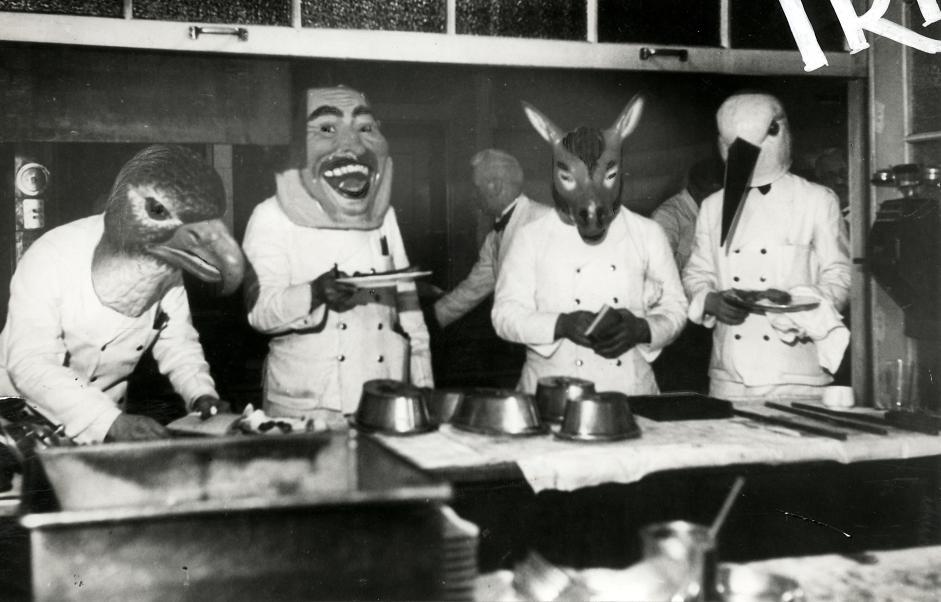
According to the global idioms quiz, in Punjabi if you want to tell someone to mind their own business, you say “keep your own owl straight”. If you want to say this makes no sense in Myanmar, “It looks like fried calabash fritters.” And in Haiti if you want to tell your kid that great-grandad died, say, “Well, honey, Great-Grandad has gone to the land of no hats.” The images that these wonderful phrases summon are so exciting! Who doesn’t want to write about the devil using your backbone as a ladder to pick apples in the garden of hell?! (Also Irish.)
So I began running a workshop built around these images, and the surreal stories I especially love. The last time I ran this workshop, one of the people wrote a piece in which “Do not board a ship without an onion” was a law punishable by death. It was one of the most breathtaking pieces I’ve ever read, and it was about an onion on a ship. There’s something about surreality that accesses a part of the brain nothing else can touch.
When I was a teenager in the 80s, the best librarians could do when I asked for surreal books was Kafka’s Metamorphosis (hot tip: if this happens to you do not then read every Kafka story you can find, because that’s the only playful thing he ever did, and if you’re already a super depressed teenager that’s only going to make it worse) and the plethora of surreal stories out there 40 years later is something I wish I could tell my teenage self about. Hold on, 1986 Sage! They’ll be here soon!

An amazing example of today’s surreality is Ai Jiang’s story, “Give me English.” The story begins, “I traded my last coffee for a coffee. How ironic. My finger jabbed at the ordering machine. The Langbase implanted in my brain popped up in front of my eyes, and I watched as the word disappeared. A heavy breath escaped my lips. I would have to trade my teas next.”
What a stunner! In the story’s world, language is commerce. And so often, in our own world, language IS commerce. If I get on a plane and go to a remote village where absolutely no one speaks my language, my ability to find food and shelter is suddenly inextricably linked to my communication skills. My very survival is at stake.
Jiang says, “I was thinking about the ways that many immigrants and those from various diasporas end up letting go of their mother tongues in favour of the dominant language of the new places they move to, the way that language is weaponized in society and used against others, the way it allows for connection but also divide.”
I’ve lived in Canada for 20 years, and sometimes I literally forget that I wasn’t born here. Canada feels entirely and irrevocably my home. But I came here from the States, where even in 2004 I found the growing right-wing movement terrifying and I was joyful upon leaving, so I’ve never missed the place I grew up.
What happens, though, when the language and culture and people are precious to the person who’s left their country? What kind of sacrifices does that person make?
What happens, though, when the language and culture and people are precious to the person who’s left their country? What kind of sacrifices does that person make? What is it like to speak a language few people in the new country speak? What happens if that language begins slipping away? The way Jiang tackles these ideas through language as commerce couldn’t be more effective.

Another gorgeous example is a story by speculative fiction author Lindz McLeod, “Against the Grain,” which begins:
“The mammoth crouches behind her desk, which is not as neat as she’d like it to be, and shuffles through papers until she finds a brochure. Pushing it across the table with her trunk, she taps the cover lightly. Muted grey, with a tasteful cream font. ‘You’ll find all our models in here, ma’am.’”
Now, a story about a mammoth who works at a funeral home could be a children’s book (I mean, a weird one, but still) with silly illustrations. It could be played for cheesy laughs for grown-ups. But McLeod creates a world in which extinct animals have been brought back to life that is not only instantly believable, but filled with characters I care about immensely by the end of the story.
McLeod says, “The story can be read as a big metaphor for any kind of Othering—sexuality, gender, race, class. I was interested to see what it would have been like to have been ‘created’ for a purpose but then discarded without filling that purpose… I think you can draw easy and clear parallels with how certain groups of people are being treated politically in the media right now; it feels timely but also, when have we be NOT been doing this as a species?”
There is something about the human brain that is willing to read about sociological terrors if it’s presented this way.
There is something about the human brain that is willing to read about sociological terrors if it’s presented this way. The people (like me) who won’t read a nonfiction book about this subject because I’m afraid I will cry non-stop for a year will not only read this story, but read it more than once. And love it. And let it change me.